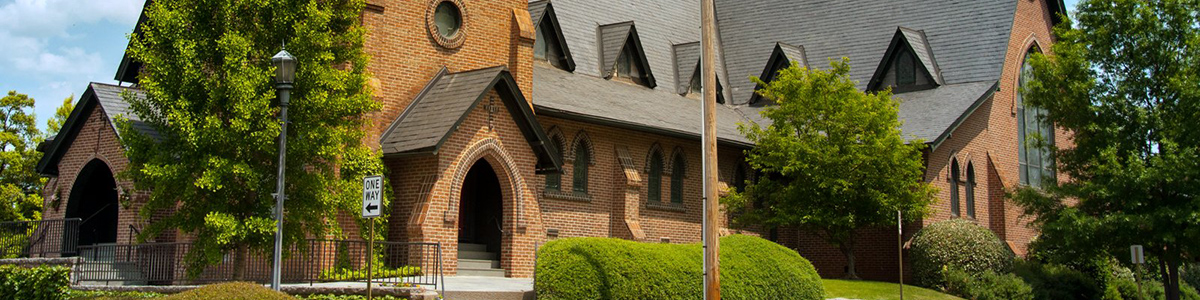
About Trinity
Trinity Episcopal Cathedral is a “house of prayer for all people.” With a history dating back to the eighteen-eighties, many have called Trinity home. Besides serving as the Cathedral of the Diocese of Arkansas, Trinity is also a vibrant, thriving parish with over 1500 members. We invite you to be involved in the worship, learning, and living of our faith in Christ Jesus, and to become a part of this wonderful community of believers. No matter where you are in your journey of faith, know that you are welcome at Trinity.
What is the Episcopal Church?
The Episcopal Church, having its roots in the Church of England, is also an Anglican Church. Like all Anglican churches, the Episcopal Church is distinguished by the following characteristics:
Protestant, Yet Catholic
Anglicanism stands squarely in the Reformed tradition, yet considers itself just as directly descended from the Early Church as the Roman Catholic or Eastern Orthodox churches. Episcopalians celebrate the “Mass” in ways similar to the Roman Catholic tradition, yet do not recognize a single authority, such as the Pope of Rome.
Worship in one’s first language
Episcopalians believe that Christians should be able to worship God and read the Bible in their first language, which for most Episcopalians, is English, rather than Latin or Greek, the two earlier, “official” languages of Christianity. Yet the Book of Common Prayer has been translated into many languages, so that those Episcopalians who do not speak English can still worship God in their native tongue.
The Book of Common Prayer
Unique to Anglicanism, though, is the Book of Common Prayer, the collection of worship services that all worshipers in
an Anglican church follow. It’s called “common prayer” because we all pray it together, around the world. The first Book of Common Prayer was compiled in English by Thomas Cranmer in the 16th Century, and since then has undergone many revisions for different times and places. But its original purpose has remained the same: To provide in one place the core of the instructions and rites for Anglican Christians to worship together.
The present prayer book in the Episcopal Church was published in 1979. Many other worship resources and prayers exist to enrich our worship, but the Book of Common Prayer is the authority that governs our worship. The prayer book explains Christianity, describes the main beliefs of the Church, outlines the requirements for the sacraments, and in general serves as the main guidelines of the Episcopal life.
Scripture, Tradition, and Reason
The Anglican approach to reading and interpreting the Bible was first articulated by Richard Hooker, also in the 16th
Century, and is known as the “three-legged stool.” While Christians universally acknowledge the Bible (or the Holy Scriptures) as the Word of God and completely sufficient to our reconciliation to God, what the Bible says must always speak to us in our own time and place. Scripture is the first leg of the stool
The Church, as a worshiping body of faithful people, has for two thousand years amassed experience of God and of loving Jesus, and what they have said to us through the centuries about the Bible is critical to our understanding it in our own context. The traditions of the Church in interpreting Scripture connect all generations of believers together and give us a starting point for our own understanding. Tradition is the second leg of the stool.
Episcopalians believe that every Christian must build an understanding and relationship with God’s Word in the Bible, and to do that, God has given us intelligence and our own experience, which we refer to as “Reason.” Based on the text of the Bible itself, and what Christians have taught us about it through the ages, we then must sort out our own understanding of it as it relates to our own lives. Reason is the third leg of the stool.
How do Episcopalians worship?
Sunday is traditionally when Episcopalians gather for worship. The principal weekly worship service is the Holy Eucharist, also known as: the Lord’s Supper, Holy Communion, or Mass. In most Episcopal churches, worship is accompanied by the singing of hymns, and in some churches, much of the service is sung.
Worship Styles
Episcopalians worship in many different styles, ranging from very formal, ancient, and multi-sensory rites with lots of singing, music, fancy clothes (called vestments), and incense, to informal services with contemporary music. Yet all worship in the Episcopal Church is based in the Book of Common Prayer, which gives worship a familiar feel, no matter where you go.
Liturgy and Ritual
Worship in the Episcopal Church is said to be “liturgical,” meaning that the congregation follows service forms and prays from texts that don’t change greatly from week to week during a season of the year. This sameness from week to week gives worship a rhythm that becomes comforting and familiar to the worshipers.
For the first-time visitor, liturgy may be exhilarating… or confusing. Services may involve standing, sitting, kneeling, sung or spoken responses, and other participatory elements that may provide a challenge for the first-time visitor. However, liturgical worship can be compared with a dance: once you learn the steps, you come to appreciate the rhythm, and it becomes satisfying to dance, again and again, as the music changes.
The Holy Eucharist
In spite of the diversity of worship styles in the Episcopal Church, Holy Eucharist always has the same components and the same shape.
The Liturgy of the Word
We begin by praising God through song and prayer, and then listen to as many as four readings from the Bible. Usually one from the Old Testament, a Psalm, something from the Epistles, and (always) a reading from the Gospels. The psalm is usually sung or recited by the congregation.
Next, a sermon interpreting the readings appointed for the day is preached.
The congregation then recites the Nicene Creed, written in the Fourth Century and the Church’s statement of what we believe ever since.
Next, the congregation prays together—for the Church, the World, and those in need. We pray for the sick, thank God for all the good things in our lives, and finally, we pray for the dead. The presider (e.g. priest, bishop, lay minister) concludes with a prayer that gathers the petitions into a communal offering of intercession.
In certain seasons of the Church year, the congregation formally confesses their sins before God and one another. This is a corporate statement of what we have done and what we have left undone, followed by a pronouncement of absolution. In pronouncing absolution, the presider assures the congregation that God is always ready to forgive our sins.
The congregation then greets one another with a sign of “peace.”
The Liturgy of the Table
Next, the priest stands at the table, which has been set with a cup of wine and a plate of bread or wafers, raises his or her hands, and greets the congregation again, saying “The Lord be With You.” Now begins the Eucharistic Prayer, in which the presider tells the story of our faith, from the beginning of Creation, through the choosing of Israel to be God’s people, through our continual turning away from God, and God’s calling us to return. Finally, the presider tells the story of the coming of Jesus Christ, and about the night before his death, on which he instituted the Eucharistic meal (communion) as a continual remembrance of him.
The presider blesses the bread and wine, and the congregation recites the Lord’s Prayer. Finally, the presider breaks the bread and offers it to the congregation, as the “gifts of God for the People of God.”
The congregation then shares the consecrated bread and the wine. Sometimes the people all come forward to receive the bread and wine; sometimes they pass the elements around in other ways.
All Are Welcome
All baptized Christians—no matter age or denomination—are welcome to “receive communion.” Episcopalians invite all baptized people to receive, not because we take the Eucharist lightly, but because we take our baptism so seriously.
Visitors who are not baptized Christians are welcome to come forward during the Communion to receive a blessing from a member of the clergy.
At the end of the Eucharist, the congregation prays once more in thanksgiving, and then is dismissed to continue the life of service to God and to the World.
Want to Learn More? Click here …


Find out what to expect when you come to visit.gif)